When the World Begins with a Question We Can't Answer
There is a kind of not-knowing that children live inside more easily than adults do.
Where does the world come from? What happens after we die? Why does the old have to end before something new can begin? These are not questions we ever fully answer — not as scientists, not as philosophers, not as parents. We simply find better and better ways of standing next to them.
Long before anyone tried to answer these questions with method or measurement, people answered them with story. And one of the oldest answers, told in different forms across very different traditions, involves a turtle.
In one telling, the world begins as nothing but water, and a turtle dives to the very bottom of it to bring back the first handful of earth. In another, after a great flood has taken everything, it is a turtle who gives her own back to become the ground the new world is built on.
I don't tell children these stories because they are historically or scientifically true. I tell them because they are true in a different way — the way a story stays alive precisely because nothing in it is fixed, and it can mean something different to you each time you return to it.
So before we talk about what Turtle means — patience, truthfulness, the willingness to let something dissolve so something else can be born — I want to leave room for a simpler question:
What do you think Turtle knows, that we don't?
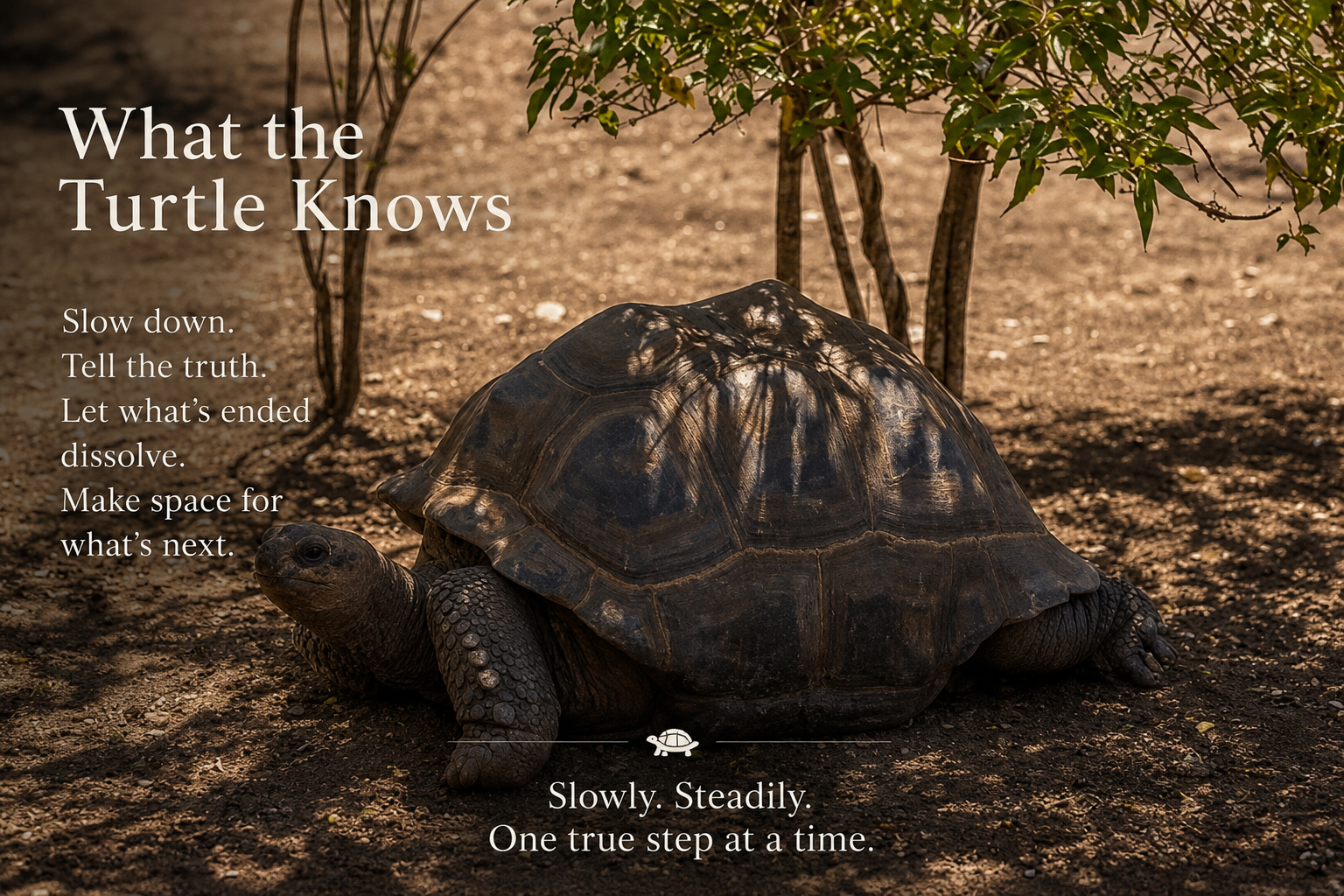
What the Turtle Knows
There's a way of talking about science's not-knowing that I think gets it slightly wrong — as if not-knowing were an embarrassment, a gap waiting to be filled. But that's not quite what it is. Science's not-knowing mostly just means: we work according to certain rules, along certain paths. It doesn't mean the rest of what we haven't answered isn't real, or isn't large, or isn't meaningful. It only means we haven't walked those paths yet — or that some paths cannot be walked that way at all.
I think it's important to stay humble here. Because once you sit with that honestly, it becomes almost impossible not to notice how much of life resists a satisfying answer. Most of us handle that in one of two ways. We avoid looking at it — we keep busy, keep certain, keep our attention on what can be measured. Or we do something older. We tell a story.
Long before there was a method for testing what's true, there were creation stories trying to hold what couldn't yet — or couldn't ever — be explained. In one telling from California, the world begins as only water, and a turtle dives to the very bottom of it to bring back the first handful of earth so that life can be made. I love this story not because it competes with what we now understand scientifically, but because it doesn't try to. It nourishes a different part of us. And there's something almost more true about a story than a fact, precisely because nothing in it is fixed. It stays alive. It can still speak to you, differently, each time you return to it. In a way, that's how the world actually began for us — as an act of imagination, long before it was anything we could measure.
There's another turtle story I keep returning to, from the Ojibwe tradition, and it asks something harder of us. After the great flood, it is Grandmother Turtle who gives herself — her own back becomes the ground the new earth is built upon. Nothing gets rebuilt without her willingness to disappear into it. For something new to be born, the old form has to fully dissolve. Not renovate. Not improve. Dissolve. And then, somehow, you have to be willing to begin again on top of what's left.
I want to ask you what that story asks: does this ring true for something in your own life right now? Is there a version of you, or a way of living, that has already ended — even if you haven't yet been willing to let it go? What would it look like to actually become willing?
In many traditions that work with animal guides, Turtle carries a particular set of gifts: truthfulness, ease, sacrifice, creation. She's slow, and steady, and she carries her home on her own back — four legs planted evenly, a tail like a rudder holding a straight line. There's something in that steadiness worth sitting with. Turtle doesn't rush toward the unknown. She also doesn't avoid it. She moves toward it at exactly her own pace, telling the truth about where she is the entire way there.
Maybe that's the real invitation, underneath both stories. Not to have an answer for everything — we won't, and pretending otherwise costs us something. But to stay honest about what we don't know, to let old forms dissolve when their time has genuinely come, and to trust that something new can still be built on what's left behind. Slowly. Steadily. One true step at a time.